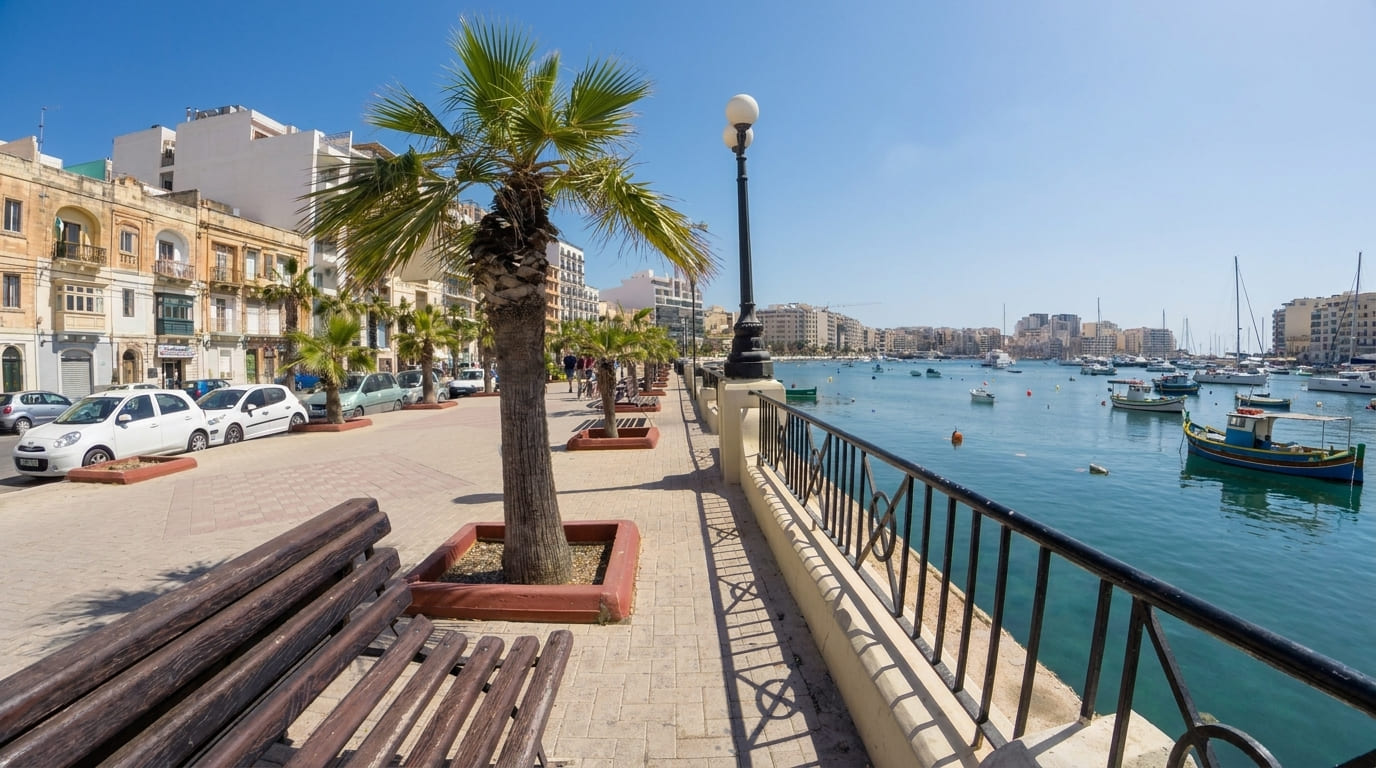
Malta is compact — you can drive end to end in 45 minutes. But for first-time visitors, choosing between Gzira, Sliema and St Julian's matters more than it looks on a map. Each neighbourhood has a completely different feel. We've been renting apartments in all three since 2015, and we see the same question from guests every week: which one should I pick?
This guide is honest rather than promotional. Each area suits a different type of traveller. Read to the end and you'll know which one is yours.
Gzira — the local option
Gzira (officially Il-Gżira, which means "the island" in Maltese) sits on the northeast coast, wedged between Sliema to the north and Msida to the south. It wraps around a narrow channel that separates it from Manoel Island — a quiet, mostly undeveloped green strip you can walk around in 30 minutes.
The neighbourhood has a real, lived-in quality that's become increasingly rare on the island. Your neighbours are Maltese families, university students from the nearby campus, and the kind of expats who've been here long enough to stop needing tourist restaurants. There are local bakeries, a weekend street market, independent coffee shops, and a promenade that connects directly to Sliema's Tower Road without any break.
"Gzira is five minutes on foot from the Sliema ferry terminal. That puts you in Valletta in ten minutes for €1.50 — the best commute in Malta."
That ferry connection changes everything about using Gzira as a base. Valletta — Malta's capital, UNESCO World Heritage Site, and where you'll spend much of your time — is right across the water. No driving, no bus, no parking. Walk to the terminal, get the ferry, arrive at the waterfront in Valletta. It runs every 30 minutes and costs very little.
Gzira is also the most affordable of the three neighbourhoods for accommodation without any meaningful compromise in quality or location.
You're staying more than four or five days. You want to feel like a resident rather than a tourist. You plan to spend a lot of time in Valletta. You prefer a quiet neighbourhood with local character. You're there in winter for a long stay. You want the promenade without the tourist crowds.
St Julian's — the centre of everything
St Julian's is the most active town on the island. At its heart is Spinola Bay — a small, horseshoe-shaped harbour where a handful of traditional fishing boats still tie up, surrounded by some of Malta's best restaurants. On a summer evening, every table around the bay is full and the atmosphere is genuinely good.
Walk five minutes in any direction and you hit something useful: a sandy beach, Malta's casino (inside the Portomaso complex), a rooftop bar, a supermarket, or a bus stop. The Hilton Malta, the Mercury Towers shopping centre, and dozens of independently owned restaurants and cafés are all within comfortable walking distance of each other.
Portomaso is a gated marina development on St Julian's eastern edge — Malta's most prestigious residential and hospitality address. One minute's walk to a sandy beach. Two minutes to Spinola Bay restaurants. The complex itself has a casino, a five-star hotel, and an outdoor pool area visible from the upper floors. It's the right choice if you want a short, comfortable stay where quality and convenience are the only priorities.
Pendergardens, just behind Portomaso, is a quieter residential complex with its own gym and pool. You're still in St Julian's — three minutes from Paceville's nightlife if you want it, but completely insulated from the noise if you don't. A good middle ground for travellers who want St Julian's access without the buzz being constant.
One thing worth knowing: Paceville — St Julian's nightlife district — sits immediately behind Spinola Bay. Over 100 bars and clubs in three streets. It's genuinely exciting if that's what you're after, and genuinely intrusive if it isn't. Plan your accommodation accordingly. Most guests who want quiet find that Pendergardens gives them the distance they need.
You're visiting for a short break and want everything accessible. You want the best restaurant options on the island. You're travelling in summer and want to be at the centre of things. You're working remotely and want quality lunch options nearby. You want beach access within walking distance.
Sliema — the comfortable middle ground
Sliema is the most established tourist area in Malta and the easiest choice for first-time visitors. Tower Road — the main coastal promenade — runs along the seafront from Sliema Ferries all the way north, broad and safe for walking at any hour. Shopping on Bisazza Street and around the main square provides everything from local pharmacies to international brands.
The Sliema Ferries terminal is right in the centre of town — ferries to Valletta run frequently and take ten minutes across the harbour. Buses to everywhere on the island depart from the same area. Taxis are easy to find at any hour. In practical terms, Sliema is the most straightforward base on the island.
The trade-off is atmosphere. Sliema is well-organised and safe, but it's also predictable. The restaurants and cafés are largely tourist-oriented, the pace is more hotel-corridor than neighbourhood street, and the coastline is rocky rather than sandy. It's a comfortable choice — but for visitors who want to experience Malta rather than just be comfortable in it, Gzira or St Julian's will reward you more.
You want maximum convenience and predictability. You're travelling with family and a consistent, well-serviced area matters most. It's your first time in Malta and you don't want to navigate an unfamiliar local neighbourhood. You want the fastest possible ferry access to Valletta.
Side by side
| Gzira | St Julian's | Sliema | |
|---|---|---|---|
| Atmosphere | Local, quiet | Lively, cosmopolitan | Tourist-facing, comfortable |
| Beach | Rocky seafront promenade | Sandy beach 1 min walk | Rocky seafront |
| Restaurants | Local spots, good value | Best on the island | Mostly tourist-oriented |
| Nightlife | Quiet | Paceville nearby | Quiet |
| Ferry to Valletta | 5 min walk to terminal | 20 min walk or bus | At the door |
| Price range | Lower | Higher | Mid |
| Best for | Long stays, winter, local feel | Short breaks, summer, beach access | First visits, families, convenience |
What about longer stays?
Between November and April, Malta shifts register entirely. Tourists go home, prices drop, and the island belongs to expats, digital nomads, and Erasmus students. If you're considering Malta for a month or more — to work remotely, study, or simply winter somewhere warm and affordable — this is when to do it.
Both Gzira and St Julian's work well for long stays. Gzira's local character becomes an asset over weeks rather than days — you end up with a routine, familiar faces, a sense of actual neighbourhood life. St Julian's keeps you better entertained on the days when work ends early and you want a good dinner.
Monthly rates for a furnished 2-bedroom apartment in either area are considerably lower than you'd expect for a capital city in the European Union, with utility bills typically included. Malta's weather in winter is mild — 15–20°C most days, occasional rain — and Valletta is easily the most underrated short city break in Europe.
Our apartments in both areas
We have properties in Gzira and St Julian's — ten apartments in Gzira Residence (five minutes from the promenade and the ferry terminal), one premium unit at Portomaso in the marina (one minute from the beach), and one in Pendergardens in the quieter part of St Julian's (three minutes from Paceville).
All are booked directly through this site. No platform, no agency — you deal with us from the first message. We've been renting in Malta since 2015 and we know all three neighbourhoods in detail. If you're still not sure which one is right for your trip, message us on WhatsApp and we'll tell you honestly.